Why Our Karate Class Sometimes Looks Like a Boxing Gym (And That's Entirely the Point)
May 5th, 2026
If you look into our dojo for the first time, on any night, peer through the door, and you might be a little confused.
Maybe you’d expect to see what most people picture when they hear the word karate - neat rows of students in white gi, performing crisp kata in unison, the air punctuated by the occasional kiai, all very disciplined and very Japanese-looking.
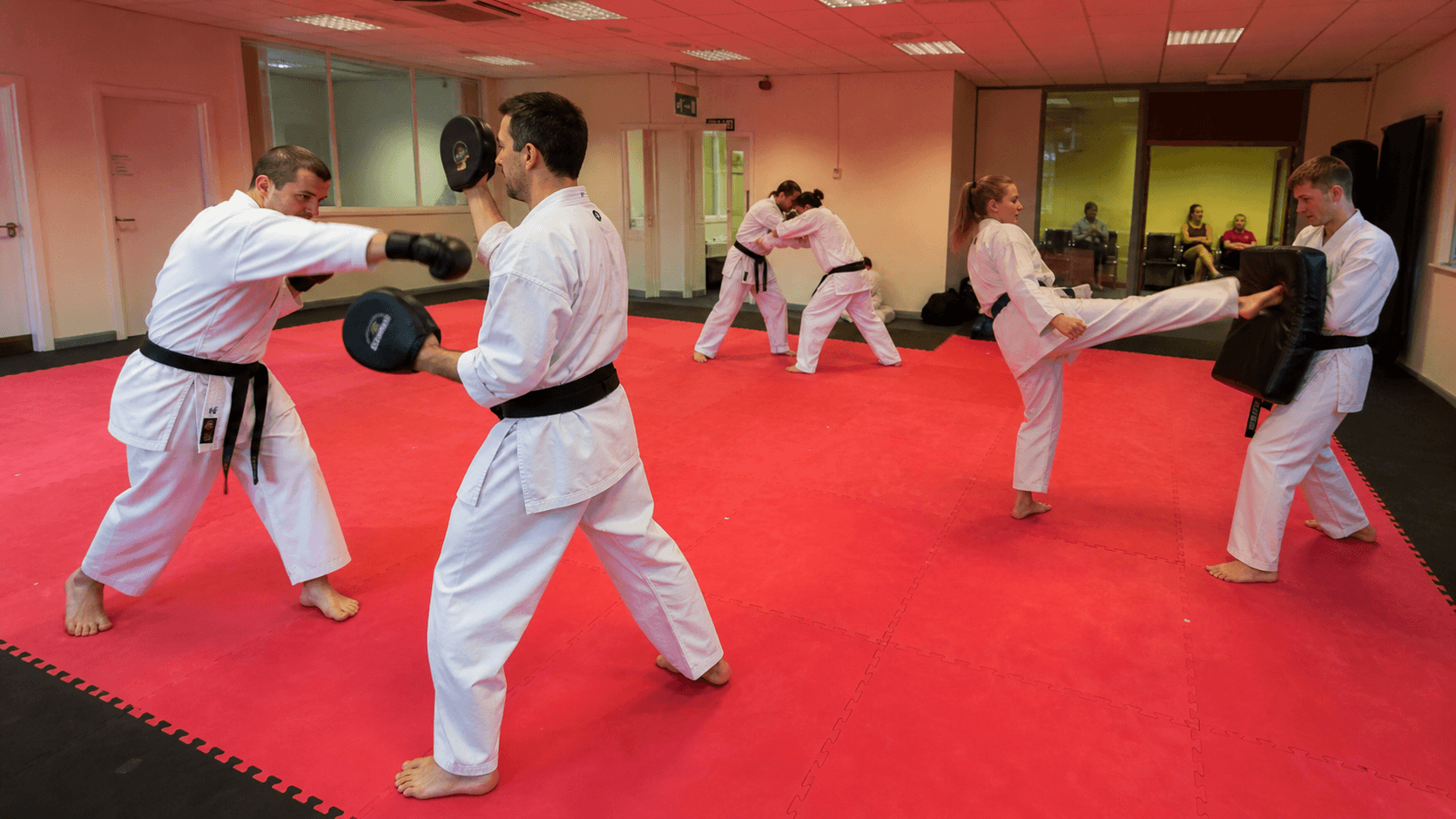
What you'd actually see is students banging out punch combinations onto focus mitts, drilling clinch entries, the thump-thump-thump of round kicks landing on a kick shield, and occasionally somebody getting put unceremoniously on their backside from a throw from a kata application.
It can look, to the untrained eye, like we've wandered into the wrong building.
We haven't. This is karate. This is exactly karate.
A small confession to start with
Before we go any further, let's get something out of the way. There's a perfectly valid, traditional way to practise karate that involves disciplined kata, formal etiquette, line drills of basic technique, and not very much pad work or sparring. Plenty of clubs do it that way. Some do it brilliantly. We've got friends who teach that way and we've got nothing but respect for them.
But here's the thing - that version of karate isn't more "real," more "authentic," or more "traditional" than what we do. In fact, in some ways, it's the less traditional version. Bear with us.
Karate, before it went to school
Karate didn't start out as a way to teach children focus and respect. It didn't start out as physical education. It didn't start out, frankly, as anything you'd associate with neat rows and white pyjamas.
It started out as te (or tī in the Okinawan dialect) - literally, "hand" - a fighting system developed on the Ryukyu Islands, the bit of the world we now call Okinawa. It was a practical, often brutal, close-quarters art designed for a very specific purpose: not getting murdered in a place where the carrying of weapons had been banned by various overlords for centuries. It was practised in secret, often at night, often in the courtyards of senior students' homes.
The original karateka trained on the makiwara (a striking post - basically the original heavy bag) until their knuckles looked like they belonged to a different species. They lifted heavy stones called chishi for grip and bodyweight conditioning. They wrestled. They threw each other around in a grappling system called tegumi. They pressure-tested techniques in informal - and not particularly polite - sparring sessions.
Sound familiar?
The kata we still practise today were created during this period, and they were created as memory aids for the techniques and tactics of this fighting art. Each movement encoded a real application - a strike, a throw, a joint lock, a takedown, a strangle. The whole vocabulary of "things one human being can do to ruin another human being's day."
This is the karate that Choki Motobu - a famously cantankerous Okinawan master born in 1870 - would have grown up in. Motobu, in his fifties, famously stepped into a ring in Japan in the 1920s and knocked out a foreign boxer in front of a crowd, an event covered by King magazine (a sort of pre-war Japanese equivalent of Reader's Digest, if it had been written by men with very strong opinions about national pride). The story of an Okinawan karateka beating a Western boxer using "the empty-hand art" was so popular it more or less single-handedly made karate famous in mainland Japan.
Worth noting: when Motobu opened his dojo in Tokyo a few years later, one of his guest students was a chap called Tsuneo "Piston" Horiguchi - one of Japan's top professional boxers. The greatest practical karateka of his generation cross-training with one of the country's top boxers, in 1927.
There is, in other words, nothing modern about karateka and boxers learning from each other.
So what happened?
Here's where it gets interesting. In 1905, an extraordinary man called Anko Itosu - Motobu's teacher, and arguably the most important figure in the popularisation of karate - got karate accepted as part of the curriculum in Okinawan schools.
This was a brilliant achievement. It also, inadvertently, changed the art forever.
To get karate into schools, Itosu had to make it suitable for schoolchildren. He couldn't very well have ten-year-olds practising the eye-gouging, throat-striking, neck-cranking applications of the original kata. So he took longer, more advanced forms and adapted them into five simpler training kata for beginners - the Pinan (or Heian) series, which most of you reading this will have learned in your first year or two. He standardised the teaching methods. He emphasised the physical-education aspects: the discipline, the lining up, the bowing.
And - crucially - he stopped explicitly teaching the practical applications. The kata stayed; the bunkai (the analysis of what each movement actually meant in a fight) was downplayed, simplified, or in many cases simply not passed on. Itosu's reasoning was practical: schoolchildren didn't need to know how to break a man's arm at the elbow joint. Schoolchildren needed exercise, focus, and discipline.
His students went on to become the most famous karate teachers of the 20th century. Gichin Funakoshi brought karate to mainland Japan in 1922 and is rightly called the father of modern karate. He also, when he got to Japan, borrowed the white uniform from judo, adopted the coloured belt ranking system from Jigoro Kano (the founder of judo), and worked hard to present karate as a respectable Japanese cultural practice rather than an Okinawan fighting art.
The result, over the following decades, was a version of karate that was beautifully disciplined, physically rigorous, philosophically rich - and, in many cases, increasingly disconnected from its practical roots.
By the time karate spread around the world in the 1960s and 70s, riding the wave of Bruce Lee films and The Karate Kid, what most of the world thought of as "traditional karate" was actually the schoolchildren's version - slightly grown up, but still essentially the physical-education curriculum that Itosu had designed for ten-year-olds at the turn of the previous century.
Iain Abernethy, who's spent the last thirty-odd years researching and teaching the practical side of karate, puts it neatly: what most of us now think of as traditional karate is, in reality, the children's version - and it's the children's version that's spread far beyond its original purpose.
The quiet revolution
Starting in the 1990s, a small group of karate instructors - people like Iain Abernethy in the UK, Patrick McCarthy in Australia, and Geoff Thompson doing his combat-pragmatism thing on the doors of Coventry nightclubs - started asking an awkward question.
If kata is supposed to be the heart of karate, and kata are full of strikes, throws, locks, and takedowns, why aren't we training strikes, throws, locks, and takedowns? Why are we doing kata in one part of the lesson, basic punches and blocks in another, and never quite bringing the two together?
The answer they came up with, and which has slowly, quietly become the foundation of what's called practical or applied karate, is that the original karate had three components that worked together:
- Kata: the encoded library of techniques.
- Bunkai: the analysis and application of those techniques against a real partner.
- Pressure-testing: making sure those techniques actually worked when somebody wasn't cooperating.
Take any one of those away, and the system breaks. Kata without bunkai becomes dance. Bunkai without pressure-testing becomes theatre. Pressure-testing without kata becomes kickboxing, which is a fine thing to be, by the way (it’s great fun), but it's not karate.
To do all three, you need things like focus mitts (to safely deliver real strikes at real speeds), kick shields (to throw real kicks with real intent), grappling dummies or willing training partners (to drill takedowns and clinch work), and yes, the occasional bit of light, controlled sparring.
Which brings us, at long last, back to your view through the dojo door.
What you're actually looking at
When you see one of our students banging out a punch combination onto a focus mitt, what they're actually drilling, most of the time, is a sequence straight out of a kata. The setup, the strike, the follow-up, sometimes the takedown.
When you see two students working a clinch entry, what they're working is the kind of close-range tussle that the older kata were specifically designed for. (Naihanchi, anyone?)
When you see somebody getting swept off their feet, that sweep didn't come from MMA or judo, it almost certainly came from a kata application. We just happen to think kata applications work better when you've actually practised them on a real, resisting human being instead of an imaginary opponent who exists in mid-air about a metre in front of you.
The boxing influence you might spot in our combinations is real, and we're not embarrassed about it. Modern boxing has spent over a century perfecting the science of how to land a punch, how to slip one, and how to chain them together. Why on earth wouldn't a striking art borrow from that?
The clinch work owes a debt to Muay Thai, which has spent centuries perfecting the art of close-range knee and elbow exchanges that, surprise surprise, look an awful lot like the close-range applications hiding in karate kata.
The grappling sensibilities? A nod to judo and jiu-jitsu, both of which share a common ancestor with karate in the older Japanese and Okinawan grappling traditions.
This is Shukokai, by the way - the style we teach. Shukokai itself was founded in the late 1940s by Chojiro Tani, a student of Kenwa Mabuni (the founder of Shito-ryu), and from the start it was designed to be more biomechanically efficient and combatively effective than what came before. Shukokai is famous for its emphasis on kumite, on power generation through hip mechanics, and on the practical application of technique. The founders of the style were already, eighty years ago, asking the same questions Iain Abernethy is asking now. We're standing on shoulders.
Still karate. Just the karate that always was.
Here's the thing. We're not trying to be edgy or modern or different for the sake of it. We learn kata, and we learn them properly. Our kata syllabus alone covers the five Pinan, Naihanchi, Annanku, Bassai Dai, Niseishi, Chinto, Matsukaze, Kosokun Sho, and Tensho, along with others.
What we're trying to do is honour karate the way it was practised before it became a school subject. With the bunkai still attached. With the pressure-testing still in there. With the cross-training still happening, because it always was happening, right back to Choki Motobu trading techniques with a Japanese boxing champion in the late 1920s.
If that sounds intimidating, please don't let it. The whole point of training this way is that technique that has to work is technique that's been tested at speed against a resisting partner, and the only way to do that safely is with controlled drills, good padwork, light contact, and the patience to build people up gradually. Beginners do not get thrown in the deep end. Beginners learn the same way everyone else has - slowly, carefully, with a great deal of laughing at our own mistakes along the way.
But yes. If you stop by the dojo and see something that looks more like a boxing gym than your idea of a karate class, that's not us doing karate wrong.
That's us doing karate the way it was originally meant to be done - kata, bunkai, and the kind of honest, sweaty, training that turns the lot of it into something you could actually rely on if you ever needed to.
We just happen to think Sensei Itosu would be quietly pleased.