
Kickboxing for Beginners: What is your first class like?
January 29th, 2026
Kickboxing for Beginners - What's it like to go to your first class?
Adults don’t usually avoid kickboxing because they’re lazy, or because they “don’t really want it.” They avoid it because their brain is trying to protect them from discomfort: embarrassment, awkwardness, feeling unfit, not knowing what to do, being the newbie, being watched… the whole cocktail. And to be fair, your brain isn’t completely wrong. Walking into a new room full of strangers and doing something physical is a vulnerable thing. It’s why so many people join a gym and then quietly drift away. Nobody tells you what’s normal. Nobody tells you what’s actually going to happen. Nobody tells you that most people in the room are just as self-conscious as you are.
So let’s do the bit that helps: let’s make the unknown known. Because kickboxing is not a “turn up and get hit” experience. Not even close. It’s fantastic exercise, a skill, stress busting, very social, and suitable for just about anyone.
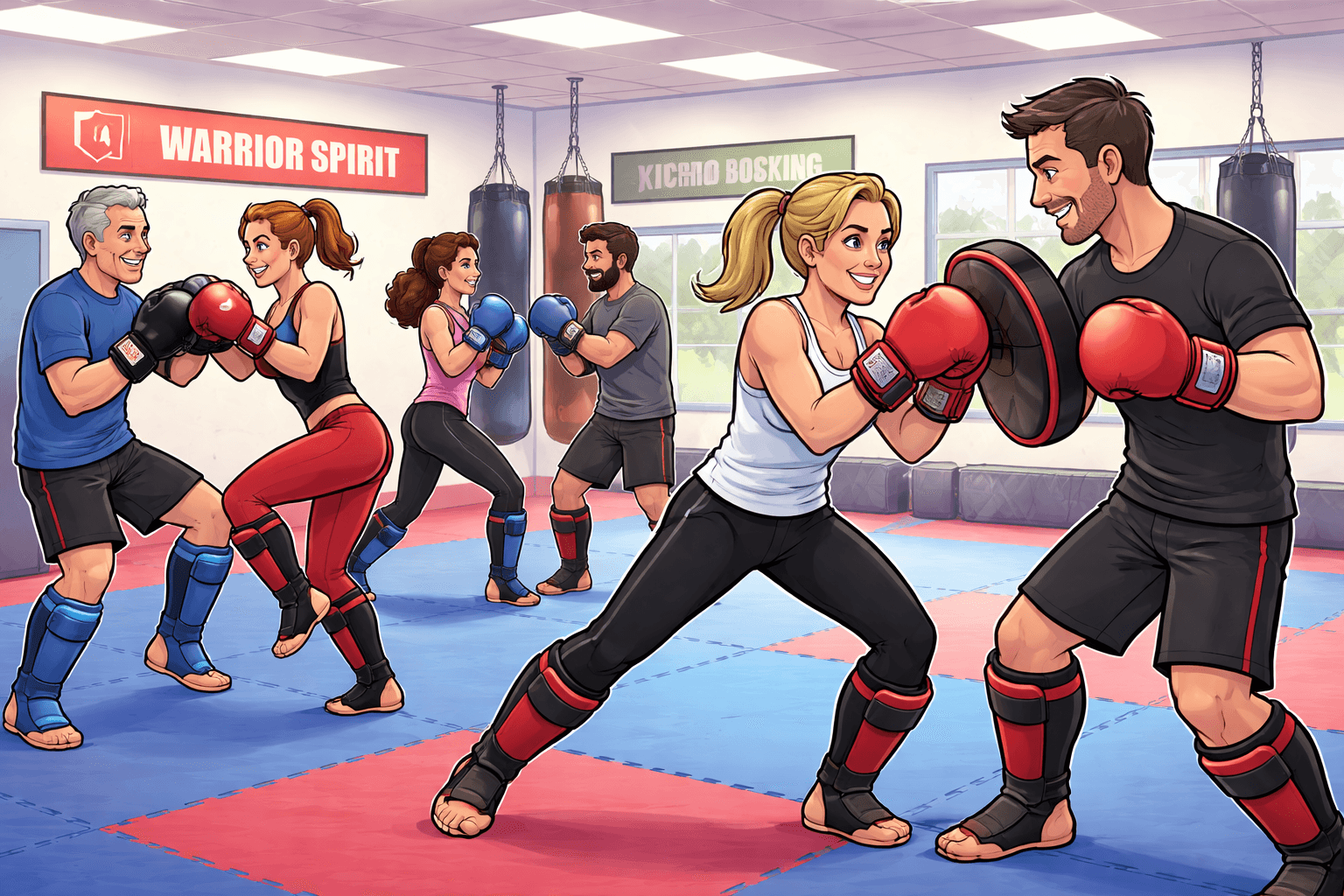
What people imagine kickboxing is… and what it actually is
A lot of people picture kickboxing as the sporty cousin of a pub fight. They imagine sparring, bruises, loud egos, and being launched into a corner like a pinball.
But most adult kickboxing classes - and ours certainly - are built around learning skills safely and getting fitter in a way that doesn’t feel like punishment. The heart of it is technique and padwork. Pads are where you can work hard, feel powerful, get a sweat on, and still feel safe.
If you’ve never done padwork before, it’s hard to explain how satisfying it is. It’s like your stress has a physical exit. Your brain stops buzzing because it has to focus. You leave feeling tired in a good way, calmer in a way that surprises you, and (this is the bit people don’t expect) proud of yourself.
And yes - the classes are mixed. In our adult sessions the gender balance is pretty much 50/50, which tells you something important: kickboxing isn’t “for men” or “for women”. It’s for adults who want to feel fitter, more capable, and more in control of their body and mind.
“But I’m nervous.” Good. That’s normal.
Nervousness is usually the sign that you care. It means this matters to you. It means you don’t want to look silly. It means you’ve built it up in your head, which is exactly what humans do.
The nervous part often isn’t even about kickboxing. It’s about walking into a new social environment where you don’t know the rules yet.
You don’t know where to stand. You don’t know what you’re expected to do. You don’t know whether people will be friendly or cliquey. You don’t know if you’ll be the least fit person there.
So your brain fills in the gaps with worst-case scenarios, and the sofa starts looking unusually supportive.
The funny thing is, once you’ve done one session, most of the fear dissolves. Not because you suddenly become confident, but because you now have evidence: “That was fine. I could do that. The room wasn’t scary. Nobody judged me. I wasn’t thrown into anything weird.”
That’s why the first class is so important. Not because it’s a test, it isn’t, but because it replaces imagination with reality.
What your first class will feel like
It won’t feel like “being thrown into the deep end.” It will feel like being coached.
There’ll be a warm-up - sensible, not sadistic - because bodies work better when they’re warm. You’ll do some simple strength exercises. Then the pads come out - You’ll learn a handful of basics. Not fifty techniques, not a complicated combination you’re expected to memorise. The basics. Stance. Guard. A couple of punches. A kick. A simple combination or two. Moving safely. How to generate power without flailing.
By this point, you’ll be involved in the silly banter in class, relaxed and probably laughing.
Padwork isn’t about being “good”. It’s about doing the movement, feeling it land, and building rhythm. You can go light at first. You can go harder as you settle. The intensity is adjustable, and that’s one of the best things about it. Two people can do the same drill and get exactly the right challenge for them.
There may be partner work as well, but in beginner-friendly classes that tends to mean controlled drills, the kind where you’re learning timing and distance, not “proving yourself”. If you’re ever unsure, you ask. If you’re uncomfortable, you say. And any decent club treats that as normal, not awkward.
You won’t be expected to spar until you’re ready and happy to, and it’s optional. You won’t be pressured into contact. You won’t be judged for going gently. The goal is that you leave thinking: “I could come back.”
Culture matters more than the workout
This is the bit people don’t talk about enough.
Two kickboxing classes can look similar on paper and feel completely different in your body.
A good class has a calm, structured atmosphere. The coaching is clear. The room feels safe. People aren’t trying to “win training”. Nobody is there to make you feel small so they can feel big.
That culture is what makes kickboxing accessible to normal adults who have jobs, kids, stress, injuries, and a limited tolerance for nonsense.
It’s also why so many people stick with martial arts when they’ve struggled with gyms. A gym often relies on self-motivation and self-direction. Martial arts gives you structure and guidance. You show up, you’re coached, you progress.
The environment is social, without kids around. Everyone helps each other out and shares in each other's progress. And progress is addictive in the best way. Not the “new year, new me” kind. The quiet kind. The kind where you notice, one day, that you don’t get out of breath the way you used to. Your shoulders are less tight. Your posture changes. Your coordination improves. You start trusting your body again.
“I’m unfit though.”
Most of us were at the beginning.
Kickboxing meets you where you are. And it has a hidden advantage over a lot of fitness approaches: it’s engaging. It uses your brain. You’re not just grinding. You’re learning. You’re focused. The time passes faster. You leave feeling like you’ve done something meaningful, not just “burnt calories”.
Also, there’s something strangely encouraging about being a beginner again as an adult. Not easy, but encouraging. Because you get to watch yourself improve in real time. You don’t have to be brilliant. You just have to be willing.
The questions people want to ask (but don’t)
Let us answer a few things that most beginners worry about, because these are the thoughts that keep people stuck:
You don’t need special kit for your first class. Comfortable clothes you can move in is enough.
You don’t need gloves on day one. If you enjoy it and want to continue, we’ll help sort you out with the kit you need, and help you to avoid what you don’t.
You won’t be the only beginner. Even if you’re the newest person on that specific day, beginners are a constant in a healthy club. People start all the time.
You don’t need to be “aggressive”. Kickboxing isn’t about becoming angry. It’s about control of your movement, your balance, your breathing, your reactions. If anything, many people find it helps them feel calmer.
And if you’re thinking “Is this suitable for me?”, there’s a good chance the answer is yes. You can start gently. You can build up. You can go at your pace and still get a great session. You can change intensity whenever you need to.
So what now?
Hopefully this gives some insight about what it’s like, but the only real way to experience it is to give it a go right? The real question isn’t “Am I the right kind of person for kickboxing?” The real question is “Is this club the right vibe for me?”.
In martial arts, we always say that the hardest belt to get is the white belt - you have to get off the sofa and make a change to get that one! The rest of them are easy, just keep showing up and working on yourself.