Karate After 50: Still Powerful - Just Different (And Honestly, Better in Some Ways)
January 26th, 2026
I’m in my early fifties now (I know right, hard to believe!). And if you’re reading this thinking, “I’m too old to start” or “I’m too old to keep going,” let me say this plainly…you’re not too old. Let’s challenge the idea that you can be too old. Not with motivational posters. Not with “age is just a number” (it’s not, it’s a collection of very real joints). But with something more useful: the reality of what changes after 50, what doesn’t, and why karate can become a richer practice than it ever was when you were younger and convinced you were indestructible.
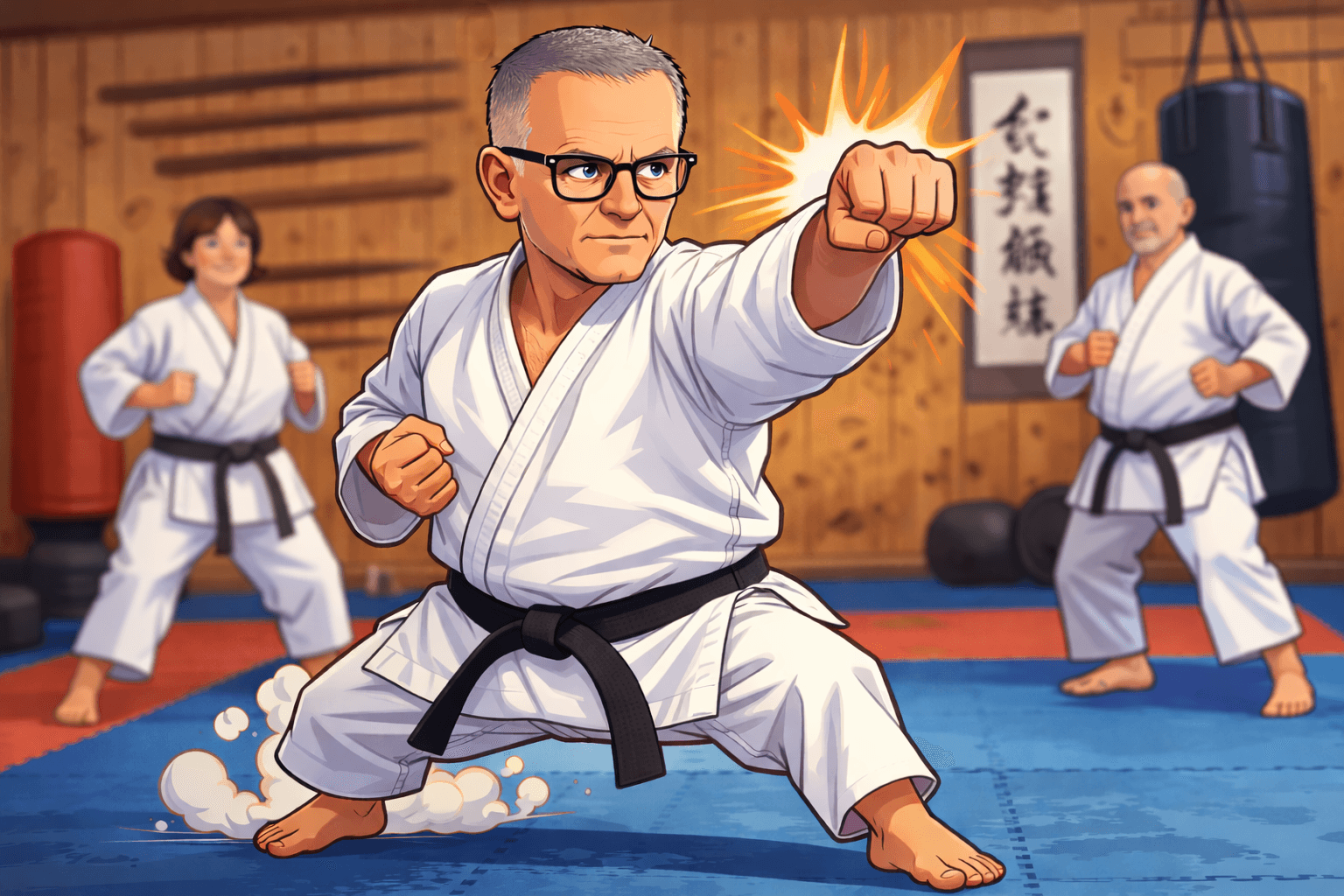
Writing this, I am celebrating Version 5.3 of myself. That’s right, 53 glorious years. I’ve trained most of my life. I don’t kick high anymore - my hips don’t enjoy that conversation, and I don’t compete now. I’ve made peace with the fact that when I stand up from the floor I sometimes make a noise that sounds like I’m trying to start a lawnmower. But I’m still training, still teaching, and still getting stronger in the ways that matter.
And in a strange twist: karate has become more valuable to me in my fifties, not less.
The big misunderstanding: “Karate is for young people”
Karate has a branding problem. A lot of people picture teenagers flying through the air, or competition highlights, or action-movie snap kicks at head height. If that’s your reference point, then yes, you might assume it’s a young person’s game.
But karate isn’t a youth sport. It’s a lifelong practice that can be trained as a youth sport...and that’s an important difference.
When you’re younger, karate often looks like speed, athleticism, and intensity. When you’re older, it can look like timing, structure, balance, awareness, and decision-making. That isn’t a downgrade. It’s a shift in emphasis, from “How impressive can I be?” to “How capable can I be?”
And capability ages remarkably well.
What actually changes after 50 (and why it matters)
Let’s not pretend nothing changes. It does.
Recovery is slower. Tendons complain more loudly. Old niggles stop being “niggles” and start having opinions. If you train like you did at 25 - same volume, same intensity, same lack of warm-up - you’ll eventually get an invoice from your body, and it’ll be payable immediately.
There’s also the broader biology of ageing: gradual losses in muscle mass and strength (sarcopenia), changes in connective tissue, and often reduced balance and reaction time if you don’t train them, and let’s not forget hair loss (in my case at least!). The good news is that these things are highly trainable, even later in life (except the hair loss, despite all the ads I see for fixing it on Instagram). Resistance training is strongly supported as a key tool for maintaining or improving muscle and function as we age.
This is where karate, trained intelligently, becomes brilliant. Because karate naturally includes many of the ingredients that health guidelines recommend for older adults: movement, strength, coordination, balance, flexibility, and social engagement. The NHS guidance for older adults explicitly emphasises being active daily, plus doing activities that improve strength, balance and flexibility at least two days a week.
Karate can cover a lot of that…if we stop treating training as a test of toughness and start treating it as a craft.
The first upgrade: you start training like an adult
A younger you might have trained like this:
- Turn up.
- Stretch for 30 seconds while talking.
- Go hard.
- Go home.
- Wonder why you feel like you’ve been hit by a small car.
The 50+ version trains differently.
You warm up properly because you’re not trying to prove anything. You prepare joints. You build heat. You respect the fact that bodies are not light switches. You manage intensity across the week. You choose when to push and when to consolidate. You stop treating soreness like a trophy.
This is not “soft”. It’s skilled.
And it’s exactly how people train when they want to keep doing something for decades rather than months.
Strength becomes the quiet hero (and it changes everything)
If there’s one area that matters more after 50 than it did before, it’s strength, not bodybuilding strength, but useful strength.
Strength makes everything else safer. It stabilises joints. It supports balance. It improves posture. It makes daily life easier. It can lower the risk of falls and the injuries that come from them, and falls really are one of the big issues as we age. The evidence base for strength and balance exercise reducing fall risk is strong, and it’s a major public health focus.
Karate isn’t a barbell programme, but it does include a lot of strength-adjacent work: stances, controlled stepping, getting up and down, bracing, moving your body through space with intent. And many older karateka benefit massively from adding a small amount of dedicated strength training alongside their karate - because strength is the thing that allows you to keep doing karate.
This is where the “martial arts is enough” crowd sometimes gets caught out. Martial arts is wonderful. But it doesn’t always give you progressive loading in the way a strength programme does. If you want to keep your knees, hips, and back happy, a little strength work is not “betraying karate”. It’s supporting it. If, like me, you teach karate to kids, you’ll get at least some of that extra strength work walking around with kids hanging off you!
Balance: the skill you don’t notice until you lose it
When you’re 25, you don’t train balance; you have balance.
When you’re 55, balance becomes something you can feel improving…or slipping, if you ignore it.
The good news is that balance is trainable, and martial arts can be a very effective way to train it because it’s dynamic, not static. You’re stepping, turning, shifting weight, changing levels. That’s gold.
There’s research showing “hard” martial arts training in older adults is associated with improvements in functional fitness parameters. And there are studies specifically looking at karate interventions and improvements in balance/neuromuscular function in older adults, even over relatively short programmes (with the obvious caveat that short studies don’t tell the whole story).
It’s also worth saying: you don’t need to do dramatic spinning kicks to train balance. You need controlled footwork, intentional movement, and enough challenge to keep the nervous system adapting.
The high-kick myth (and the hip negotiation)
Let’s talk about the elephant in the dojo: high kicks.
High kicks are impressive. They’re also optional.
If your hips don’t like high kicks anymore, that doesn’t mean you’re “bad at karate.” It means you’re an adult with joints, and your karate is evolving.
A lot of practical karate doesn’t require high kicking anyway. Low kicks, knee strikes, stomps, sweeps, stepping, angling, and controlling distance are often more relevant to real-world self-protection and are generally kinder to older hips.
Also, and I say this with affection: the older you get, the more you realise that falling over is not a minor inconvenience. It’s a whole event. It has admin.
So we train with that reality in mind.
You know what, though? If one actually needs to kick head-height, the smart karateka knows to kick to the knee first to make it achievable (obviously reserved only for the most demanding self defence scenario, and definitely not in class)!
Kata stops being a performance and becomes a laboratory
One of the best surprises of training after 50 is what happens to kata.
When you’re younger, kata can become a perfection chase. Crisp lines. Sharp stops. “Is my stance deep enough?” “Is this angle exactly right?” You can get obsessed with the surface.
After 50, if you let yourself, kata becomes something better: a laboratory.
You start asking different questions:
- Where does power actually come from now that I can’t rely on raw athleticism?
- What happens if I make the movement smaller but more connected?
- Where am I tense?
- Where am I rushing?
- What’s the functional meaning of this sequence at close range?
- How can I use this movement?
This is where karate becomes deep. It stops being about looking like karate and starts being about understanding it.
And the funny thing is, you often become more dangerous in this phase. Not because you’re faster, but because you’re more efficient and you waste less movement.
Bunkai and close-range work: where “older karate” gets very practical
As we age, we tend to become less interested in “dojo fantasy fighting” and more interested in what actually happens when things go wrong.
Distance collapses quickly in real situations. People grab. They shove. They clinch. They crowd.
That’s why, in our approach at Warrior Spirit, grappling and close-range control are not side quests - they’re part of a complete syllabus.
And this is another reason karate after 50 can be excellent: you can train close-range skills in a way that is highly effective and still manageable on the body. Control, posture, balance disruption, escapes, getting up safely - these are skills that matter, and they can be trained progressively and responsibly.
There’s also growing interest in martial arts as a broader intervention for older adults, including potential cognitive and mental health benefits. Not because it’s magic, but because it combines physical challenge, coordination, attention, and community.
Sparring after 50: it’s not “stop” - it’s “choose”
A lot of people assume that once you hit 50 you either spar exactly as before, or you don’t spar at all.
That’s a false choice.
The real choice is: what kind of sparring serves your goals and your body right now?
There’s a world of difference between:
- technical, controlled sparring with agreed intensity (I’ve been a fan of super light sparring for many years now)
- situational drills (e.g., escapes from a grab, clinch entries, wall pressure)
- padwork with a partner
- heavy, ego-driven rounds where someone is trying to “win training”
Some of those tend to build skill and confidence. The others tends to build injuries and regret.
As an older karateka, you get to be picky. That’s not weakness. That’s wisdom.
And honestly, the dojo culture improves when everyone realises sparring is a tool, and not a personality trait.
The real superpower of training after 50: consistency
You don’t need heroic sessions. You need repeatable sessions.
Consistency beats intensity when the goal is longevity. That’s not just a nice saying, it’s how adaptation works over time. If you can train often enough to keep the thread unbroken, you get fitter, stronger, calmer, and more capable. If you train like a maniac once every two weeks and spend the rest of the time recovering, you get…very good at spending time in recovery.
The mindset shift: “that’ll do” is not giving up, it’s growing up
At some point, you stop chasing perfection.
Not because you don’t care, but because you care about the right things.
You still polish technique, but you’re not emotionally hostage to it. You accept that some days you’re stiff. Some days your timing is off. Some days you’re distracted because you’ve got a a day job, four children, a dodgy knee, and the boiler is making a noise that sounds like it’s learning to sing.
And you train anyway.
That’s the mature martial artist: not the one who looks perfect, but the one who keeps showing up.
Mental health: the benefit nobody puts on the poster
The physical benefits are obvious. The mental ones can be bigger.
Karate gives you a place where your brain has to be present. You can’t doomscroll in a stance. You can’t overthink your way through padwork. You can’t catastrophise while trying to coordinate breath, posture, timing, and distance.
You get an hour or so where you’re in your body, with other human beings, working at something meaningful.
That combination - physical challenge + attention + community - is exactly why martial arts are increasingly discussed as supportive for mental wellbeing in older adults.
And if you’ve spent decades carrying responsibility (work, family, life), having a space that’s structured, safe, and purposeful is not a small thing.
So…is karate after 50 worth it?
If you want karate to stay exactly the same as it was when you were 20, then no, it isn't.
But if you’re willing to let it evolve, karate after 50 can be one of the best things you do:
- for strength and balance
- for mobility and joint health (when trained sensibly)
- for confidence and capability
- for mental clarity
- for belonging to a community
- for that deeply satisfying feeling of continuing to grow
And in a slightly mischievous twist: as you get older, karate stops being about proving something and starts being about understanding something. That’s where it gets genuinely interesting.
If you want to try an adult class, or just come and listen to my joints creek, we’ll train you safely, progressively, and properly. And we’ll never ask your hips to do anything they haven’t agreed to in writing.
I hope you enjoy this insight into what it's like to be my age in karate. I absolutely love it!
Si (aged 53 and ¾)